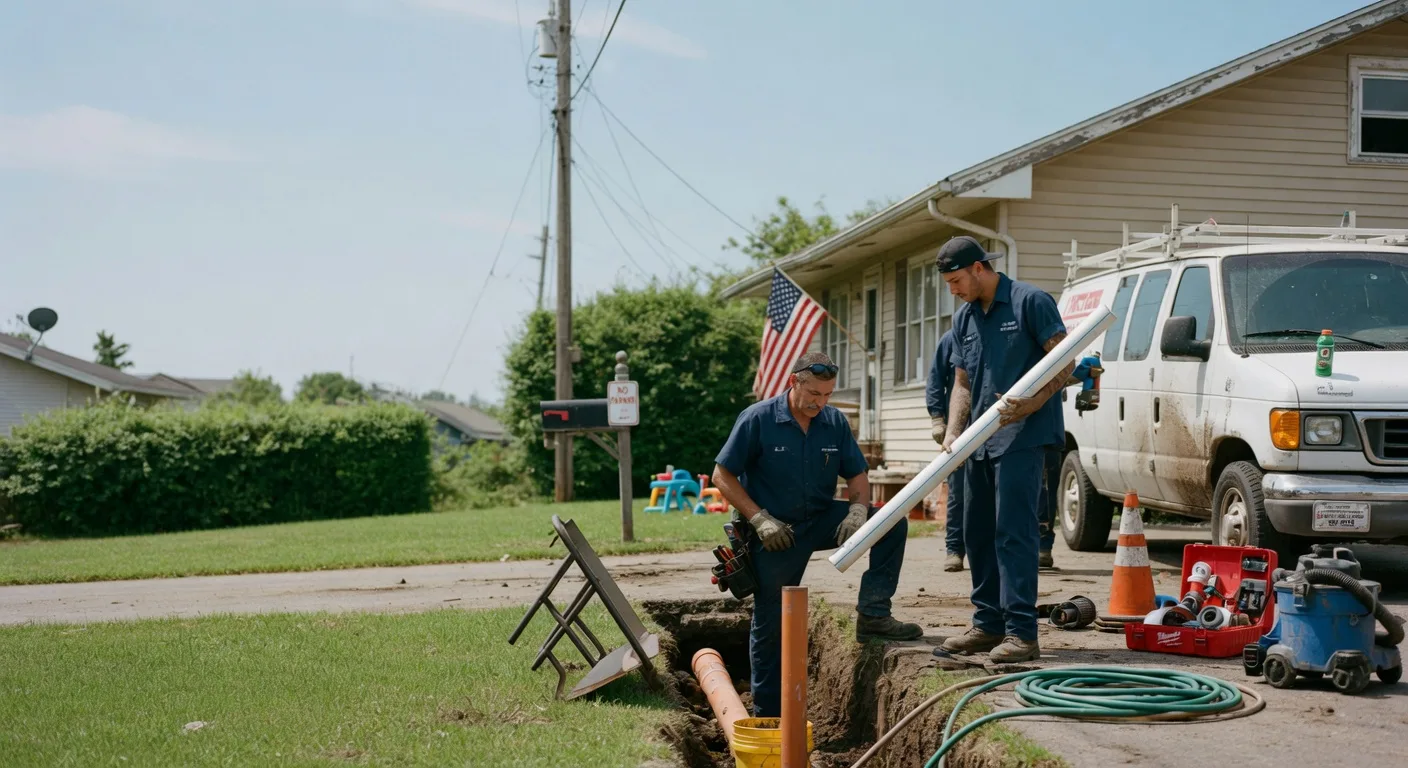
What is a cleanout and why does the plumber keep asking if I have one?
A cleanout is a capped pipe fitting that gives a plumber direct access to the sewer line. It usually looks like a round plug, three or four inches across, sitting on a short stub of pipe. You will often find one in the basement near the main stack, in a crawlspace, along an outside wall or in the yard near the foundation.
The plumber asks because it decides how the job is done. With a cleanout, a cable machine or hydro jetter goes straight into the line. Without one, the equipment has to go in through a toilet, a floor drain or the roof vent. That can mean pulling a toilet, and it limits how far the machine travels and how well a camera can see.
Safe homeowner check: find the cap and note where it is. Do not unscrew it if the house drains are backed up. Water can be standing behind the cap, and it will come out.
Stop running water and call now if the cleanout is wet or leaking, or if several drains in the house are backing up together. That points to a blockage in the main line.
If your home has no cleanout, adding one is often part of the job. What it costs depends on access, how deep the line is, how much has to be dug or cut open, and whether a permit applies.
Expert Plumbers Co is a referral service. Call (380) 262-9173 and we will connect you with a plumber serving Phelps, NY for Drain Cleaning.
A few practical points help when a cleanout is involved. The cap can be stuck from years of rust or paint, and forcing it with a long wrench can crack the fitting, so leave a stubborn one to the plumber. Keep the area around it clear of storage, snow, soil or landscaping so the crew can reach it quickly. In older homes the cleanout may have been buried when the yard was regraded, or covered by a patio or flooring, and finding it can take some probing. Newer homes usually have one near the foundation or at the property line, sometimes with a green or black cap flush with the lawn. If a plumber can find or install one, later cleanings and camera inspections become simpler and less disruptive, because the equipment enters the line at a planned point and nothing indoors has to be disturbed or removed.
What is a bellied or sagging sewer line, and can it be cleaned?
A belly is a low spot in the sewer line where the pipe has sunk. Water and waste stop and sit in the dip instead of flowing on. Solids settle there, grease coats the pipe wall and paper catches. You see it as drains that run slow, a toilet that needs repeated flushing, or a line that clogs again a few weeks after it was cleared.
The cause is usually a pipe that lost support underneath it, or a joint that shifted.
Can it be cleaned? Yes, up to a point. A cable machine can open a blockage sitting in the belly, and hydro jetting can wash grease and buildup off the pipe wall. Neither fixes the dip. The belly keeps holding water, so the buildup returns.
A camera inspection tells you the rest. It shows how deep the belly is, whether the pipe is cracked, and whether roots have entered a joint. Cost depends on how deep the line is, how much has to be dug up or removed, the materials involved and any permit.
Safe homeowner check: note whether one fixture or the whole house is slow. One fixture points to its own branch. Every drain slow points to the main line.
Stop running water and call now if sewage is coming up in a tub, shower or floor drain.
Expert Plumbers Co is a referral service. Call (380) 262-9173 and we will connect you with a plumber serving Phelps, NY for Drain Cleaning or Emergency Drain Cleaning.
Left alone, a belly tends to get worse in a predictable way. The standing water softens the soil around the pipe further, the dip deepens, and the clogs come back faster each time. Another warning sign is a faint sewage smell in the yard or a patch of lawn that sinks or stays wet, which can mean the pipe has separated at a joint. Older homes with clay or cast iron lines are the most likely to have a belly, because those pipes sit in sections and shift as soil settles. Newer plastic lines can also sag when the trench bedding was uneven. When you speak to the plumber, ask what the camera shows about the depth of the dip and the condition of the pipe at that spot. If the pipe is intact, a spot repair may be possible. If it is cracked, replacing that section is the lasting fix.
Does hard water cause drain problems, or only water heater problems?
The bathroom sink used to run fine. Now it drains a little slower each month. That slow creep is the sign of scale, not a clog.
Hard water does more than coat a water heater. Minerals from the supply side leave a chalky layer inside a trap. In a bathroom line they bind with soap residue into a hard, grey film. The bore narrows a fraction at a time, so you notice a gradual slowdown rather than a sudden blockage.
Old cast iron is a different problem. Inside drain pipe that has been in the ground or a wall for decades, rust forms lumpy mounds called tubercles. These are not hard-water minerals. They are the pipe corroding from within, and they snag grease and paper.
The two tools do different work. A cable punches a hole through the build-up. Water drains again, but the scale stays on the wall and the line narrows again. Hydro jetting strips the wall back to the pipe surface.
Jetting old iron hard without looking first is a gamble, because thin, flaking pipe can fail under pressure. That is why a camera inspection comes first on old iron. It shows wall condition and cracks before anyone sets the pressure.
Safe homeowner check: find out whether one fixture is slow or every drain in the house is, then clean the visible stopper and trap.
Stop running water and call now if several drains slow together, or water backs up at a floor drain. One slow bathroom sink is usually a cable or trap job. A whole-house slowdown in old iron often needs a camera first and possibly jetting.
Expert Plumbers Co is a referral service. We connect you with an independent local plumber in Phelps, NY. Call (380) 262-9173.
A water softener changes the picture a little, and it is worth telling the plumber if you have one. Softened water leaves less mineral scale, but it can feel slippery and does not stop soap and hair from building up on the pipe wall. If your water is hard and you have no softener, the mineral film inside traps and short branch lines is the main cause of the slow creep. A simple habit helps: use a hair catcher in the tub and basin, and rinse the sink with hot tap water after use so soap does not cool and settle on the wall. Do not rely on vinegar or store-bought descalers to clear a drain, as they only treat the surface. In newer homes with plastic pipe, scale is mostly a trap and fixture issue. In older homes with iron or galvanized pipe, scale and corrosion together can narrow a line enough that replacing a section is more sensible than repeated cleaning.
There is a soggy strip, a sinkhole or an unusually green line of grass over where my sewer runs. Is that a broken sewer line?
It can be. A wet strip, a dip in the lawn or a stripe of grass that is greener than the rest, all following the path of the sewer, is a classic sign that the pipe is leaking into the soil. Waste water carries nutrients, so the grass above it grows lush while the ground underneath stays soggy.
A sinkhole is more serious. If soil is washing into a cracked or separated pipe, it leaves a void that grows over time. The surface may look fine until the roof of that void gives way. Keep people, pets and vehicles off the area and do not fill it yourself with a quick load of dirt, because the hole will usually return.
Other things can look similar, so check before assuming. A leaking irrigation line, a broken water supply pipe or a downspout discharging at that spot can all soak a strip of lawn. A simple test: shut off every tap and appliance, then look at your water meter. If it keeps moving, the leak is likely on the supply side, not the sewer. If the meter is still, and you also notice slow drains, gurgling, a sewage smell outdoors or backups, the sewer is the stronger suspect.
Safe checks you can do:
Note where the wet or green strip runs and whether it lines up with the cleanout or the path to the street. Reduce water use until the line is looked at.
Stop running water and call now if sewage is surfacing, a hole is opening, or drains inside the house are backing up.
Cleaning alone does not fix a broken pipe. A camera inspection is how a plumber finds the break, shows how far the damage runs and tells whether the pipe is cracked, offset at a joint or collapsed. Repair can then be a spot repair, a liner through the existing pipe, or replacement of a section. Cost is driven by depth, length of pipe affected, what sits on top of it such as a driveway, trees or a patio, how much has to be excavated, the pipe material and permits under local code. To be connected with an independent local plumber in Phelps, NY, call Expert Plumbers Co on (380) 262-9173.
I rent out my place and the tenant says the drains are backing up. What should I ask them, and what should I arrange?
Start with a few plain questions, because the answers tell the plumber where the problem is before anyone arrives.
Ask the tenant which fixtures are affected. One slow sink or tub points to a clog in that fixture's own branch. If several drains are slow, or water rises in a tub or shower when the toilet is flushed or the washer empties, the main line is the likely culprit.
Ask when it started and what changed. Did it follow heavy rain, a laundry day, a large gathering, or a new habit such as flushing wipes? Ask whether there are gurgling sounds, a sewage smell, or water in a floor drain or basement. Ask whether anything has already been tried, especially chemical cleaners, since those are a hazard to whoever opens the pipe next.
Ask for photos or a short video of the fixtures. That is faster than a long phone call and helps if you are not living nearby.
What to tell the tenant right away: stop running the washer and dishwasher, go easy on the toilets, and do not pour cleaner down the drain. If sewage is coming up inside the home, or water is spreading across a floor, treat it as urgent and keep people and pets out of the wet area.
What to arrange: a plumber to clear the line and, if the same drain has failed before, a camera look at it. Offer the plumber the tenant's contact details and agreed times so access is not the delay. Ask whether the blockage was in the fixture branch or the main line, and whether the plumber thinks it was caused by tree roots, a sagging pipe or something that was flushed. That tells you whether it is a one-off or a repair item.
Keep notes: dates, photos, what the plumber found. Whether the cause is wear or misuse affects the conversation with the tenant, so write down what was seen rather than what was assumed. Check your lease and local rules for your own obligations.
Expert Plumbers Co can connect you with an independent plumber in Phelps, NY for this: call (380) 262-9173.